



Skull model of a kanglion
This is a model of the skull of a kanglion. The most prominent feature of the bag lion is its large, scissor-like split meat teeth (located on the sides of the upper and lower jaws), and large front, rodent or primate-like incisors, rather than the canines of modern cats. It was not a real lion, but a carnivorous marsupial that lived in Pleistocene Australia. It is the largest carnivorous mammal in Australian history. It has a strong bite force and can hunt prey much larger than its own size.

Cave bear skull fossil
This is a fossil skull model of a cave bear. The cave bear (scientific name: Ursus spelaeus) is a bear that lived in Europe and Asia during the Pleistocene and became extinct about 20,000 years ago during the Ice Age. They are much larger than today's brown bears, standing up to 10 feet (about 3 meters) tall and weighing more than 1600 pounds (about 725 kilograms). Because most of their fossils were found in caves, they showed that they were more dependent on caves for habitat and hibernation than existing brown bears, hence the name "cave bear".
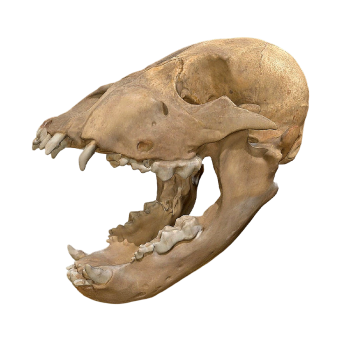
Cougar Skull
This is the skull of a cougar (American Lion). The cougar (Panthera leo atrix) is an extinct species of feline, one of the largest known. They lived during the Pleistocene (Pleistocene) and became extinct about 10,000 years ago. The cougar was found primarily in North America, from Alaska to Mexico, and was a predator at the top of the North American food chain at the time. As pure carnivores, their tooth structure is ideal for piercing and tearing meat, and their canines are large.

Specimen of Fa
The moa is a bird of the family Ostryiidae. The abdominal feathers are yellow, and the other parts are yellow and black. The body is hypertrophy, the upper limbs are degraded, and the lower limbs are thick and short; the neck is covered with feathers and is short; there are 3 toes. In 1843, Owen named it a terror bird, meaning a large bird that frightens people. In the middle of the 18th century, it was preyed on by European immigrants; by the late 18th century, it was becoming more and more difficult to be caught; 1800 was the last year that people could catch it. The North Island population of New Zealand became extinct in the 17th century and the South Island population became extinct in 1850.

Peregrine Falcon Specimen
Peregrine Falcon, scientific name: Falco rusticolus, Falconidae. The largest falcon has a body length of 45-60cm and a wingspan of 90-115cm. Its beak is curved and sharp, and its feet are covered with strong pectinate scales, which are suitable for tearing prey. The body is stout, the male bird is 48-56cm long, and the female bird is larger (58-60cm); The male bird is grayish blue with dark stripes on the abdomen, and the female bird is brownish brown with dark spots. The staple food lemmings, snow rabbits, puffins and pheasants can subduction at speeds of more than 200 kilometers per hour and use gravitational acceleration (about 25g) to kill them.

Specimen of Green Broad-billed Bird
Green broad-billed bird, scientific name: Calyptomena viridis, passerine broad-billed bird family, round and fat body, broad and short beak, body feather mainly emerald green, throat with chestnut patches, female body color is darker than male birds. Tropical rainforests of Southeast Asia, including Malaysia, Indonesia (Sumatra, Borneo), southern Thailand and Singapore. It inhabits lowland primary forests, secondary forests and bamboo forests, usually below 600 meters above sea level. Banyan fruit (such as figs), berries, insects (beetles, caterpillars) and spiders; wide beak can quickly peel fruit pulp.

large salamander specimen
Large salamander, scientific name: Siren lacertina, genus Blunt-mouthed salamander, alias: lizard salamander, swamp salamander. No hind limbs, short forelimbs, mucous glands on the body surface, body length up to 90cm, smooth skin without scales, yellowish brown to dark green, with dark stripes or spots. Freshwater wetlands in southeastern North America, including Florida, Georgia, Alabama and the Mississippi River Basin. It inhabits swamps, peat bogs, streams and rice fields, usually 0.5-1.5 meters deep, and depends on humus substrates. Stamp food aquatic insect larvae (mosquitoes, mayflies), crustaceans.

Gannet Specimen
Gannet, scientific name: Morus bassanus, gannet family Booby. The largest gannet, with a body length of 80-100cm and a wingspan of 165-180cm, has a long beak with an inflated tip, pure white feathers, black wing tips, and blue-green bare skin at the base of the beak. North Atlantic and North Pacific temperate and frigid waters, breeding sites concentrated in Canada, Ireland, the United Kingdom, Iceland and the northern islands of Japan. Non-breeding period spread to tropical waters, but rarely deep into the equator. The staple food is sardine, mackerel and other cluster fish, which can catch 1-3 fish in a single dive. Young birds need adult individuals to feed with ruminant and semi-digested food.

Galapagos Tortoise Specimen
The scientific name of Galapagos tortoise (Galapagos giant tortoise): Chelonoidis nigra, tortoidae, is one of the largest tortoises with a shell height of 1.2 meters and a weight of 417 kilograms. The carapace is dome-shaped or saddle-shaped and is differentiated according to subspecies. The life span can reach more than 150 years. Cactus, vines, grass as staple food, gastric acid strong acid decomposition of wood fiber. The rainy season replenishes petals and fruits, and the dry season relies on lichen and prickly pear cactus.

Emperor Penguin Specimen
King penguins (Aptenodytes) Emperor penguins (Aptenodytes forsteri) are mainly distributed in Antarctica and surrounding sub-Antarctic islands (such as South Georgia Island and Ross Sea), and inhabit floating ice areas and coastal ice-free zones. Penguins have the largest body shape, black and white feathers, and orange-yellow patches on their ears and beaks, adapting to the polar cold environment. Body height of up to 1.2 meters, weight 22-45kg, is the largest existing penguin. Carnivorous, with Antarctic krill (90% of the diet), fish (such as Antarctic cod) and cephalopods as the staple food, diving depth of up to 500 meters.
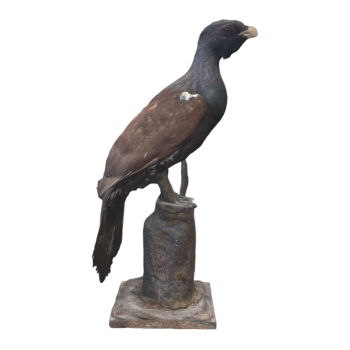
Big grouse specimen
Big grouse (scientific name: Tetrao urogallus) is the largest bird in the grouse. It is distributed in the cold temperate coniferous forest and mixed forest in Eurasia. It is known as "Thunderbird in the forest" because of its unique courtship behavior and ecological importance ". Distributed in Scandinavia, northwestern Russia, the Alps. Siberia, northern Mongolia and the Daxinganling region in northeast China. It relies on mature coniferous forests (such as spruce and fir) and forest edge shrubs, preferring areas with deep snow cover and sheltered wind.

armadillo specimen
Armadillo, Armadillo (scientific name: Cingulata, family name: Dasypodidae) is a unique mammal living in the Americas. There are about 20 species. Its iconic feature is the bone plate carapace covering the whole body, which is called "living armor". Mainly distributed in Central and South America, north to the southern United States (such as the nine-banded armadillo Dasypus novemcinctus), south to Argentina. Belonging to the order Cingulata, it is closely related to the extinct eagle-toothed beast (Glyptodon) and is a unique branch of mammalian evolution in South America.

spotted deer specimen
The spotted deer (scientific name: Axis axis) is an even-hoofed animal of the genus Deer, Deer. Standing shoulder height 0.6-1 meters, body length of about 1.5 meters. Bucks horns, trifurcated, up to 75cm long. This species has a red body color and white on the abdomen, inside of the legs and under the short tail. Males tend to be darker in color and have black markings on their faces. Characteristic white patches appear in both sexes and extend in longitudinal rows throughout the animal's life. A black dorsal stripe runs across the animal's back.

Spanish Goat
Goat (scientific name: Capra hircus) is a mammal of the genus Bovine Goat. Also known as summer sheep, black sheep. There are more than 150 goat breeds in the world, including dairy goat and hairy goat; there are more than 40 goat breeds in China, including Yimeng black goat and Cangshan black goat. The goat has a compact structure, a deep and broad chest, arched ribs, a straight back and waist, a large abdomen without drooping, regular limbs, strong bones, well-developed and elastic breasts, and large and neat nipples. Tip of mouth, sharp teeth, thin lips. Both male and female sheep have horns and beard. The coat is mostly white, accounting for more than 85%, the outer layer is coarse hair and the inner layer is fluff.

Twisted Horned Forest Antelope Specimen
The hornbeam antelope is a mammal of the genus Bokolinga in the order Artiodactyla. The fur is predominantly gray, with a white streak with distinct V-shaped white hairs on the nose and small white dots on both sides of the face. The ears are funnel-shaped, with long laryngeal spikes; only males have horns, the horns 1.7 meters long. The average life expectancy is 8-12 years. The horned antelope is distributed in eastern to southern Africa. It inhabits translucent forests or dense irrigation, often in mountainous or rocky areas. Active diurnal, 5-6 females form groups without rank, while 2-10 males form single groups. Vegetarian animals that feed on leaves, plants, tubers, flowers, and fruits.

Iranian Sheep Specimen
Ovine (Ovis aries) is a mammal of the genus Ovine in the family Boviidae, in the order Artiodactyla. The body is plump and covered with dense hair. Short head; Rams have large spiral horns, ewes have no horns or small horns; The skull has a tear socket and the nasal bone is relatively raised. Four hooves have toe glands; The tip of the mouth and lips are thin and flexible. Weight ranges from tens of kilograms to more than 100 kilograms, with a natural life span of about 15 years.

lazy bear specimen
The lazy bear is a mammal of the genus lazy bear in the order Carnivora, with a black body, rarely dark brown or reddish brown, a crescent-shaped white spot on the chest, and a light-colored nose and face. The hair is long and messy. Under feeding conditions, life can reach 40 years. The sloth bears are found in Sri Lanka, India, Nepal and Bhutan. It inhabits early and humid forests, shrubs, savannas and grasslands, mostly below 1500 meters above sea level, and occasionally up to 2000 meters above sea level, such as the Western Ghats in India. It feeds mainly on termites, but also on small vertebrates, fruits, and insects.

sheep specimen
Ovine (Ovis aries) is a mammal of the genus Ovine in the family Boviidae, in the order Artiodactyla. The body is plump and covered with dense hair. Short head; Rams have large spiral horns, ewes have no horns or small horns; The skull has a tear socket and the nasal bone is relatively raised. Four hooves have toe glands; The tip of the mouth and lips are thin and flexible. Weight ranges from tens of kilograms to more than 100 kilograms, with a natural life span of about 15 years.

Specimen of the Horned Antelope
The ornis belong to the bovidae. The neck of the horned antelope is relatively short, and the shoulder is slightly higher than the hip. The limbs are thicker and the feet are wide. The tail is round and thin, 25-35cm long, with long hair at the end. The hair in winter is long and rough, mainly grayish brown, and the hair in summer is sandy yellow. The forehead of the head has large black tufts of hair. Small eyes; The horns of both male and female are about 80cm long and female, and female, and female, which are relatively thin, curved posteriorly and then upward, respectively, and slightly resembled a flat spiral. There is also an easy to identify feature, in their forehead has a much darker than the body hair color, and the face hair is whiter than the body hair.

goat specimen
Goat (scientific name: Capra hircus) is a mammal of the genus Bovine Goat. Also known as summer sheep, black sheep. There are more than 150 goat breeds in the world, including dairy goat and hairy goat; there are more than 40 goat breeds in China, including Yimeng black goat and Cangshan black goat. The goat has a compact structure, a deep and broad chest, arched ribs, a straight back and waist, a large abdomen without drooping, regular limbs, strong bones, well-developed and elastic breasts, and large and neat nipples. Tip of mouth, sharp teeth, thin lips. Both male and female sheep have horns and beard. The coat is mostly white, accounting for more than 85%, the outer layer is coarse hair and the inner layer is fluff.

Starling specimen
Also known as black starling, a bird of the genus starling family. The body is large, 23-28cm long, black throughout, with a long and vertical feather cluster on the forehead, resembling a crown. The tail feathers and the overlying feathers under the tail have white end spots. The mouth is milky yellow and the feet are yellow. Sounds like starling, trained to imitate human language, is a famous cage bird. It feeds on insects such as locusts and flies, and also eats plant foods such as grains, plant fruits and seeds. It is a social bird that likes to move with its peers. It will form a group of dozens to hundreds of birds, forage and inhabit together, and maintain the relationship between the groups through complex communication methods.

White tailed sea eagle specimen
The White tailed Eagle, scientific name Haliaeetus albicilla, is a large raptor widely distributed in temperate Eurasia. They usually live near large open water bodies, such as coastal saltwater areas, inland freshwater lakes, wetlands, and rivers. The white tailed sea eagle is known for its strong hunting ability and opportunistic scavenging behavior, mainly preying on fish and waterbirds.

Przewalski's Mustang specimen
The Przewalski's horse is a mammal belonging to the mammalian family Macroma in the order Neodactyla; Its body shape is similar to that of a domestic horse, with a large head and thick neck, short and round ears, no long frontal hair, short and upright mane, a black ridge line in the center of the back, short tail base hair, and black front of the lower limbs; Its summer fur is light brown on the back, light on the sides, and yellow white on the abdomen; its winter fur is long and thick, with a lighter color, appearing light yellow. The Przewalski's wild horse is also known as the Mongolian wild horse or the Junggar wild horse. Due to multiple reasons such as ruthless hunting by humans and the deterioration of the ecological environment in their habitats, Przewalski's horses became extinct in the wild in the mid-20th century.

Blue antelope specimen
The Blue Antelope is a member of the Oxidae family, with a shoulder height of approximately 102-120 centimeters and a weight of around 180 kilograms. Its gray fur appears blue gray under strong sunlight. Distributed in South Africa, it became extinct in 1799 AD.

Popular Models
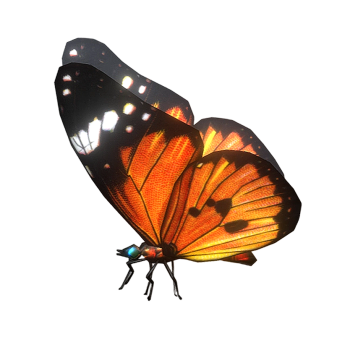
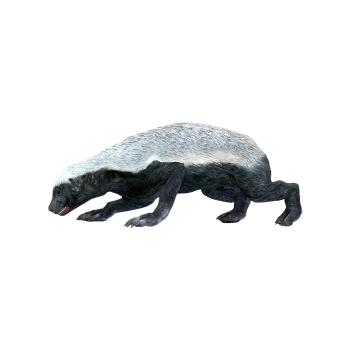
Honey Badger (3D animated model)
192 View
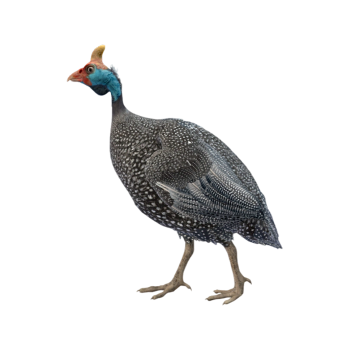
Guinea fowl (3D animated model)
163 View
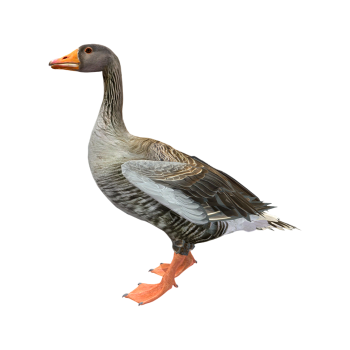
Wild Goose (3D animated model)
185 View
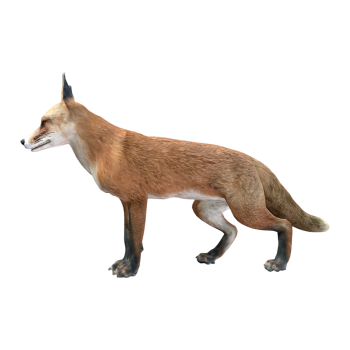
Red Fox (3D animated model)
153 View
Random Model


Piano keys (Casio VL tone)
1084 View

Olympus XZ-2
1217 View


Surveillance camera
973 View




giraffe
1582 View